Stainless steel Fermentation Tank: Most Recommended Manufacturers, Suppliers and Quotes Quality Assured
Looking for stainless steel fermentation tank solutions that are reliable, hygienic, and built for long-term performance?
Whether you are planning a brewery expansion, setting up a winery, launching a kombucha brand, or upgrading an industrial
bioprocess line, the right stainless steel fermentation tank can directly affect product quality, process stability,
and operational efficiency. This guide provides industry-focused, SEO-friendly information about manufacturers,
suppliers, quotes, and quality assured purchasing considerations without naming any specific companies.
It is designed as evergreen content for blog pages, category pages, and industry landing pages.
A stainless steel fermentation tank is one of the most important vessels in modern fermentation systems. It is used across
beverage production, food processing, dairy applications, pharmaceutical bioprocessing, and industrial fermentation. Because these tanks are
expected to maintain cleanliness, resist corrosion, and support controlled fermentation conditions, buyers often prioritize quality assurance,
material grade, fabrication standards, and supplier capabilities when requesting quotes.
What Is a Stainless Steel Fermentation Tank?
A stainless steel fermentation tank is a purpose-built vessel designed to support controlled fermentation by holding and
processing liquids or semi-liquid materials under specific environmental conditions. These tanks are engineered to withstand pressure,
temperature changes, cleaning chemicals, and repeated production cycles while maintaining sanitary conditions.
Stainless steel is the preferred material because of its durability, cleanability, and resistance to contamination. Depending on the
application, a fermentation tank may be used for yeast propagation, alcoholic fermentation, aerobic fermentation, anaerobic fermentation,
microbial cultivation, or product maturation. In many industries, the tank is not only a container but also a critical process asset that
helps improve consistency and product yield.
Why Stainless Steel Is the Preferred Material for Fermentation Tanks
The popularity of the stainless steel fermentation tank comes from its strong balance of hygiene, mechanical strength,
and long service life. Unlike many alternative materials, stainless steel supports strict sanitation protocols and can be engineered with
smooth internal surfaces that reduce residue buildup.
- Corrosion resistance: Stainless steel resists moisture, acids, and many fermentation byproducts.
- Hygienic performance: Its non-porous surface helps minimize bacterial retention and cross-contamination.
- Mechanical durability: It performs well under pressure, agitation, and thermal cycling.
- Long service life: Properly fabricated tanks can operate for many years with correct maintenance.
- Easy cleaning: Stainless steel supports CIP and SIP procedures in industrial environments.
- Professional appearance: The material delivers a clean, polished look suitable for commercial facilities.
Common Applications of Stainless Steel Fermentation Tanks
Stainless steel fermentation tanks are used in a wide range of industries. When buyers search for stainless steel fermentation tank manufacturers
or request quotes from suppliers, their application usually determines the technical requirements, capacity,
pressure rating, and accessories needed.
Industry |
Typical Use |
Key Tank Features |
|---|
Brewery |
Beer fermentation and conditioning |
Cooling jackets, pressure control, conical bottom, CIP system |
Winery |
Wine fermentation and storage |
Temperature control, sanitary finish, sample port, airtight sealing |
Dairy |
Yogurt, cultured milk, starter cultivation |
Hygienic design, temperature regulation, gentle agitation |
Food processing |
Fermented sauces, enzymes, food ingredients |
Food-grade stainless steel, sanitary fittings, cleanability |
Pharmaceutical |
Microbial and bioprocess fermentation |
High precision, validation support, GMP-compatible fabrication |
Biotechnology |
Cell cultivation and production fermentation |
Instrumentation ports, sterile design, process monitoring |
Kombucha and craft beverages |
Beverage fermentation at various scales |
Sanitary tank design, easy cleaning, scalable capacity |
Key Advantages of Stainless Steel Fermentation Tanks
Buyers and procurement teams often compare different tank materials before choosing a stainless steel fermentation tank.
The advantages below explain why stainless steel remains the dominant choice in many fermentation systems.
Advantage |
Business Value |
|---|
Sanitary design |
Supports safer production and reduces contamination risk |
Corrosion resistance |
Improves tank lifespan and protects product integrity |
Customizable structure |
Allows manufacturers to build tanks for different processes |
Temperature control compatibility |
Enhances fermentation stability and product consistency |
Pressure capability |
Suitable for pressurized or sealed fermentation systems |
Low maintenance |
Reduces downtime and lifecycle cost |
Scalable production |
Can be made from small pilot volumes to large industrial capacities |
Types of Stainless Steel Used in Fermentation Tanks
Material selection is one of the first items buyers should verify when requesting a quality assured quote for a
stainless steel fermentation tank. The most common grades are selected based on corrosion resistance, cleanliness,
and intended process conditions.
Stainless Steel Grade |
Main Characteristics |
Common Use |
|---|
304 / 304L |
General-purpose, good corrosion resistance, widely used in sanitary equipment |
Food, beverage, light industrial fermentation |
316 / 316L |
Higher corrosion resistance, better performance in acidic or chloride-rich environments |
Brewing, dairy, pharmaceuticals, aggressive process media |
Dual-grade options |
Balances strength and corrosion resistance depending on system requirements |
Custom fermentation systems and specialized applications |
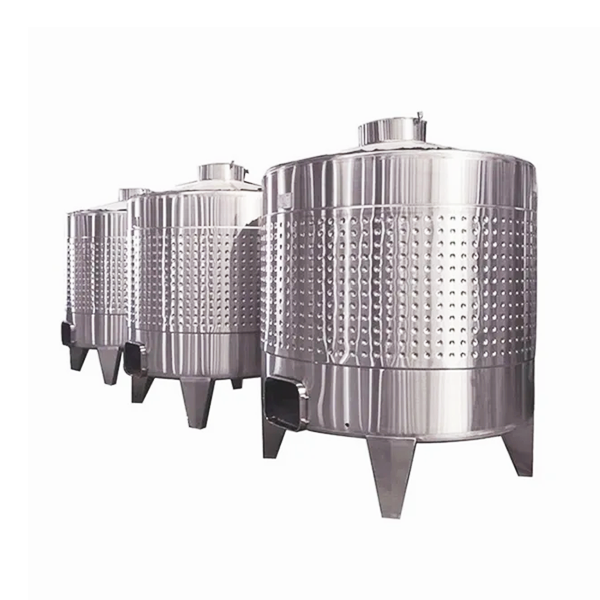
Typical Structural Components of a Fermentation Tank
A professionally manufactured stainless steel fermentation tank includes several structural and functional elements. The exact
configuration depends on the industry and process design, but many tanks share the same core components.
- Tank body: Main vessel section that holds the fermentation medium.
- Conical or flat bottom: Designed for sediment collection, drainage, or process flow.
- Top cover or manway: Provides access for inspection, cleaning, and maintenance.
- Cooling jacket: Supports thermal control during fermentation.
- Insulation layer: Helps stabilize temperature and improve efficiency.
- Agitator or mixer: Used in specific fermentation processes requiring movement.
- Instrumentation ports: Allow sensors, probes, and gauges to monitor process conditions.
- Inlet and outlet fittings: Support filling, sampling, discharge, and cleaning.
- Level indicators and sight glass: Help operators monitor volume and status.
- Valve and drain system: Facilitates safe emptying and sanitation.
Standard Specifications Buyers Commonly Compare
When requesting stainless steel fermentation tank quotes, buyers typically compare the specifications below. These factors
influence cost, lead time, and system suitability.
Specification Item |
Common Options |
Why It Matters |
|---|
Capacity |
Small pilot scale to large industrial volume |
Determines production scale and quote range |
Material grade |
304, 304L, 316, 316L |
Affects corrosion resistance and hygiene level |
Design pressure |
Atmospheric to pressurized |
Important for safety and process requirements |
Design temperature |
Ambient, chilled, heated, or wide-range |
Supports fermentation control and product stability |
Surface finish |
Polished, sanitary, mirror-finish options |
Improves cleanability and contamination control |
Bottom style |
Conical, sloped, flat |
Impacts drainage and sediment removal |
Cooling system |
Jacketed wall, dimple jacket, internal coil |
Maintains target fermentation temperature |
Accessories |
Sensors, valves, manways, pressure relief devices |
Supports full process integration |
Certification level |
Food-grade, sanitary, GMP-related, pressure vessel standards |
Impacts compliance and purchase confidence |
How Manufacturers of Stainless Steel Fermentation Tanks Add Value
Reliable stainless steel fermentation tank manufacturers do more than fabricate vessels. They help buyers match
technical requirements with production goals. A good manufacturer can provide design input, material guidance, fabrication precision,
testing support, and delivery coordination.
In general, manufacturers add value through custom engineering, welding quality, sanitary finishing, documentation, and compliance support.
For buyers seeking quality assured equipment, the manufacturer’s process capability is just as important as the tank itself.
Tanks built with careful weld treatment, smooth internal surfaces, and proper fitment are easier to clean and more dependable during long-term use.
What Suppliers Typically Provide
Suppliers of stainless steel fermentation tanks often support the commercial side of procurement.
Depending on their business model, they may act as distributors, exporters, system integrators, or direct factory partners.
The best suppliers help customers compare options, organize logistics, and manage after-sales support.
- Product selection guidance
- Specification confirmation
- Quotation preparation
- Lead time estimation
- Packaging and shipping support
- Technical documentation
- Spare part coordination
- Installation or commissioning assistance
How to Request a Quality Assured Quote
A quality assured quote for a stainless steel fermentation tank should be based on accurate process data.
The more complete your inquiry, the more precise the pricing will be. Incomplete information often leads to generic quotes that require
revision later.
To receive a useful quote, buyers should typically provide the following details:
- Required tank capacity
- Application and product type
- Material grade preference
- Operating temperature range
- Pressure requirement
- Need for jacketed cooling or heating
- Surface finish expectation
- Cleaning method, such as CIP
- Required ports, valves, and sensors
- Destination market and compliance needs
- Delivery deadline
- Packaging or installation requirements
A clear quote should include price, technical specification summary, production lead time, payment terms, warranty details, and shipping
conditions. For larger projects, it may also include drawings, process assumptions, and optional upgrades.
Factors That Influence Stainless Steel Fermentation Tank Price
The price of a stainless steel fermentation tank varies widely depending on design complexity and manufacturing standard.
Buyers searching for the most recommended manufacturers and suppliers should understand the main cost drivers
before comparing quotes.
Price Factor |
Impact on Cost |
|---|
Tank capacity |
Larger tanks require more material, labor, and freight space |
Material grade |
316L is generally more expensive than 304/304L |
Custom design |
Special dimensions, ports, and accessories increase engineering work |
Surface finishing |
Higher polish and sanitary finish levels add fabrication cost |
Pressure rating |
Pressurized systems require stronger construction and testing |
Temperature control system |
Jackets, coils, and insulation add materials and assembly time |
Automation level |
Sensors and control integration increase overall project value |
Shipping method |
Freight, crating, and export handling affect final cost |
How to Evaluate a Fermentation Tank Manufacturer or Supplier
If you are comparing stainless steel fermentation tank manufacturers or screening potential suppliers,
use a structured evaluation process. This can help you avoid unexpected quality issues and quote discrepancies.
- Check fabrication capability: Review whether the supplier can build the required size and design.
- Confirm material traceability: Ask about material certificates and source verification.
- Inspect weld quality: Welds should be clean, consistent, and suitable for sanitary use.
- Review surface finish: Internal surfaces should support cleaning and contamination control.
- Ask about testing: Pressure testing, leakage testing, and inspection processes matter.
- Verify customization options: Ensure the supplier can adapt the tank to your process.
- Request documentation: Technical drawings, manuals, and quality records should be available.
- Evaluate communication: Fast and accurate responses often indicate professional project handling.
- Compare warranty terms: Good suppliers clearly define warranty and service coverage.
- Assess export experience: International buyers should confirm packaging and logistics capability.
Quality Assurance Standards for Stainless Steel Fermentation Tanks
Quality assurance is central to the purchase of a stainless steel fermentation tank. The tank should not only look professional
but also perform safely and consistently in production. Quality assured products often follow strict fabrication and inspection practices.
Common quality-related expectations include:
- Accurate dimensional manufacturing
- Proper welding and finishing
- Leak testing before shipment
- Material compliance documentation
- Sanitary design principles
- Reliable fittings and seals
- Strong corrosion resistance
- Process-specific functional testing
For regulated industries, documentation may also include inspection records, calibration support, certificates of conformity, and process
validation assistance. These elements improve buyer confidence and reduce commissioning risk.
Popular Customization Options
Modern stainless steel fermentation tank manufacturers often offer a broad range of customization options. These options
allow the tank to better fit a specific product line or factory layout.
Customization Option |
Purpose |
|---|
Conical bottom |
Improves sediment removal and product discharge |
Cooling jacket |
Maintains fermentation temperature |
Insulation |
Reduces energy loss and stabilizes process conditions |
CIP spray ball |
Supports automated cleaning |
Sampling valve |
Allows quality checks during fermentation |
Pressure relief valve |
Improves operational safety |
Level gauge |
Helps monitor product volume |
Temperature sensor port |
Enables precise process monitoring |
Top manway |
Provides internal access for maintenance and inspection |
Stainless Steel Fermentation Tank Size Guide
Tank capacity should align with your production goals, batch cycle, and available floor space. The ideal size is not always the largest;
it is the one that best supports operational efficiency and consistent product quality.
Size Range |
Typical Use |
Buyer Priority |
|---|
Small scale |
Pilot trials, startups, specialty batches |
Flexibility and low initial investment |
Medium scale |
Growing beverage and food production |
Balance between volume and process control |
Large scale |
Commercial and industrial manufacturing |
Throughput, automation, and long-term efficiency |
Why Buyers Search for the Most Recommended Manufacturers and Suppliers
Search intent around most recommended stainless steel fermentation tank manufacturers and suppliers
usually reflects a need for trust, performance, and value. Buyers want reliable equipment, but they also want a supplier that understands
sanitation, technical details, project timing, and after-sales support.
In practice, the most suitable supplier is often the one that can offer:
- Clear and responsive communication
- Professional technical drawings
- Custom design support
- Stable fabrication quality
- Competitive yet transparent pricing
- Reliable delivery schedules
- Strong documentation and quality assurance
Frequently Requested Quote Information
Many buyers prepare a request for quotation with the following format. Including these details helps suppliers return a more accurate
quality assured quote for a stainless steel fermentation tank.
RFQ Field |
Example Content |
|---|
Product type |
Beer, wine, kombucha, dairy culture, bio-fermentation medium |
Tank volume |
Specified in liters, gallons, or other units |
Material |
304L or 316L stainless steel |
Process condition |
Atmospheric or pressurized fermentation |
Cooling requirement |
Jacketed, insulated, or no cooling system |
Accessories |
Manway, sensors, valves, sight glass, sample port |
Compliance need |
Food-grade, sanitary, GMP-related, export standard |
Delivery location |
Country, port, warehouse, or project site |
Final Thoughts
A stainless steel fermentation tank is a high-value asset for modern production environments that require cleanliness,
durability, and consistent process control. When comparing manufacturers, suppliers, and quotes,
buyers should focus on material grade, fabrication quality, surface finish, temperature control, and documentation. A well-designed,
quality assured tank helps improve product consistency, reduce contamination risk, and support efficient long-term operation.
If you are building an industry page, blog article, or product category page, this content can be used as a strong SEO foundation for
keywords related to stainless steel fermentation tank manufacturers, stainless steel fermentation tank suppliers,
stainless steel fermentation tank quotes, and quality assured fermentation tank solutions.
```
 +86 29-87031531





 핸드폰
핸드폰
논평
(0)